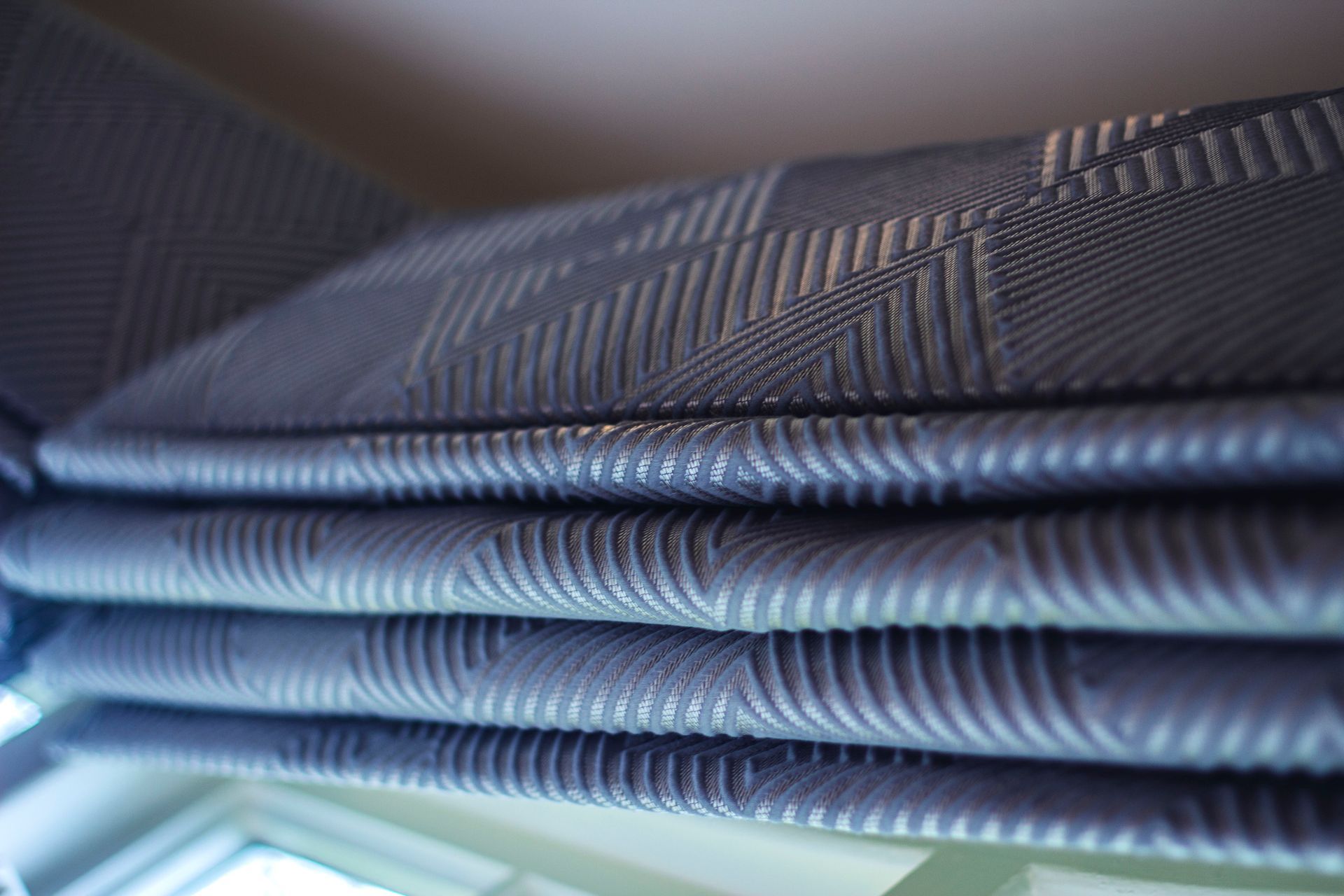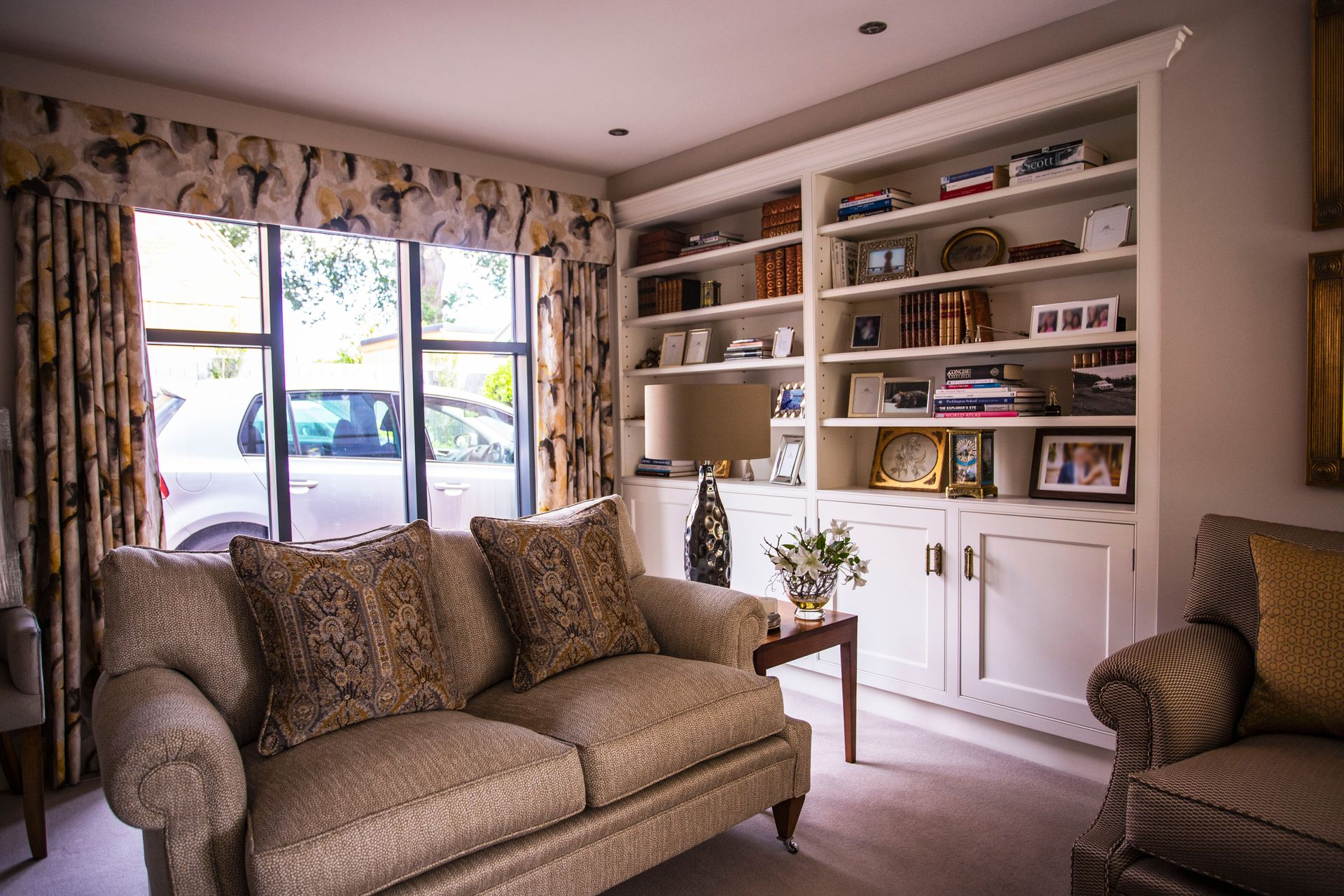
Curtain Design, Making & Installation.

Most people know what they want their curtains to feel like. They have a sense of the fabric, the weight, the way they'd like light to fall through them in the morning. What's harder to know - until you've seen it go wrong - is how much expertise stands between that feeling and the finished result.
At Carol Bird Interiors, curtains are not an afterthought at the end of a scheme. They are a considered part of it from the beginning. And the experience that goes into them - from the first conversation about proportion through to the final installation - spans more than four decades.

Design: Proportion First, Fabric Second
The question isn't simply which fabric you love. It's whether that fabric - that weight, that pattern repeat, that heading style - is right for this window, in this room, with this light.
A bay window is a different proposition to a sash. A dormer has its own requirements entirely. Ceiling height changes things. The aspect of the room changes things. A south-facing drawing room that floods with afternoon light needs a different treatment to a north-facing bedroom where warmth and depth matter more.
Every room is different. And the brief for the room has to inform the curtain design, not the other way around.
That's where experience shows itself quietly. Knowing when a pelmet adds architecture and when it diminishes a window. When a valance softens a room and when it clutters it. When a blind alone is the right answer and when it isn't. When a pole suits the proportions and when a track - concealed and functional - will serve the scheme better. When a pencil pleat heading works and when a more considered heading would elevate the whole room.
These aren't decisions you make from a pattern book. They come from having made them - correctly, and occasionally incorrectly - thousands of times over thirty years.

Making: What Hand-Finished Actually Means
There is a version of curtain-making that is fast, functional and entirely forgettable. And then there is what our workroom does.
Over forty years of making experience sits behind every pair of curtains that leaves our hands. That means understanding which fabrics will hang beautifully and which, without the right support, will do something else entirely. It means knowing when interlining is essential - not just for warmth and light exclusion, but for the way a properly interlined curtain moves and falls, the way it feels when you touch it.
It means knowing before the fabric is cut whether this particular cloth, in this heading, at this drop, is going to do what you're expecting of it.
Our seamstresses bring that understanding to every job. The finishing is done by hand. Not because it's a selling point, but because that's the only way to do it properly - and anyone who has held a hand-finished curtain alongside a machine-finished one understands the difference immediately.
Simon Oldfield, who came to us when furnishing his new home in Beverley, put it simply: "We are delighted with the quality of the workmanship." That's the standard we hold ourselves to. Every time.

Installation: The Part That Cannot Be an Afterthought
We have installed curtains the length and breadth of this country. Cornwall, London, Liverpool, Hull. We have installed in Spain - many times - and in the Caribbean. When you are travelling that kind of distance to hang curtains in a client's home, the margin for error is, shall we say, slim.
Care and attention are not optional at that point. It's a long way to come back.
But here's what I find myself thinking about more and more: it isn't distance that focuses the mind. It's having seen, over the years, what happens when installation is treated as the easy part.
I have lost count of the times I've arrived at a job - our own job, or one we've been asked to sort out - and found tracks that were never right for the window they were specified for. Motors that aren't rated to carry the weight of the curtains hanging from them. Runners that make operating the curtains harder than it should be, not easier.
On one job, the situation was extraordinary. A bay window, corded track, and the wrong runners fitted - corded at one end only. The client, bless him, had been hanging his full body weight off the track to get it to move. We sorted it for him. But I still find it difficult to understand how that track was ever signed off in the first place.
That kind of error doesn't happen at Carol Bird Interiors. Not because we're infallible, but because the people doing the installation understand curtains - the weight, the mechanism, the load, the movement - and they've been doing this long enough to know what right looks like before anything goes up.
Installation is where all the work that came before it either proves itself or falls apart. A curtain that was designed with care, made with skill and hung incorrectly is a disappointment. The whole point is that it shouldn't be.
If you're thinking about new curtains - one room or several, here in Beverley or further afield - come and see us. The showroom is open Monday to Friday, 10am to 4pm. Evenings and weekends by appointment.
The conversation costs nothing, and getting the brief right from the start makes everything else straightforward.
Frequently Asked Questions
Q: Do you only install curtains locally in East Yorkshire? A: Not at all. We've installed across the UK - from Cornwall and London to Liverpool and Hull - and internationally in Spain and the Caribbean. Most of our out-of-area work comes through existing client relationships, but wherever the project is, the standard is the same.
Q: How do you decide whether curtains need to be interlined? A: It depends on the fabric, the heading, the drop and what you're trying to achieve in the room. Interlining adds body, improves insulation and changes the way a curtain hangs and moves. It isn't right for every treatment, but when it is right, the difference is immediately visible. We'll talk you through it as part of the design process.
Q: Can you help if a previous curtain installation has gone wrong? A: Yes. We've stepped in on a number of occasions to sort out problems caused by incorrect specification - the wrong track for a window type, motors not rated for the curtain weight, runners that make the whole thing unworkable. If something isn't right, come and speak to us.
Q: What's the difference between a pelmet, a valance and a heading - and how do I know which is right? A: A pelmet is a structured, often shaped board above the curtain that conceals the track and adds architectural weight to a window. A valance is a soft, gathered fabric treatment that creates a similar effect with more softness. The heading refers to how the curtain itself is gathered or pleated at the top - pencil pleat, pinch pleat, eyelet and so on. Which is right for your room depends on the window proportions, ceiling height, the style of the room and what you're trying to achieve. It's exactly the kind of decision we work through with you from the start.
Q: Do I need an appointment to visit the showroom? A: You're welcome to come in without an appointment Monday to Friday between 10am and 4pm. For evenings and weekends, we ask that you book ahead. Either way, you'll find plenty to look at - and plenty of people who can talk you through it properly.
About David Bird
David Bird is the principal designer at Carol Bird Interiors, 47 North Bar Within, Beverley - one of the last full-service traditional design houses in East Yorkshire. Liberty of London trained, with over thirty years leading residential and international projects from single rooms to complete estates. If you know what you want your home to feel like but aren't sure how to get there, that's exactly where the conversation starts.